Skip to Content Skip to Footer
Wyoming WIC
Wyoming WIC
  • Home
  • Women
    • Women
      Breastfeeding
    • Women
      Healthy Tips for Moms
    • Women
      Postpartum
    • Women
      Pregnant
  • Infants
    • Infants
      Feeding & Nutrition
    • Infants
      Growth & Development
  • Children
    • Children
      Toddlers
    • Children
      2-5 Year Olds
  • Families
    • Families
      Activity and Play
    • Families
      Dads
    • Families
      Food & Family Meals
    • Families
      Immunizations
    • Families
      Safety
  • Live Well Blog
  • Food Shopping Guide
  • Español
weight-gain-during-pragnancy

Weight Gain During Pregnancy – How Much?

  • Home
  • Live Well Blog
  • Weight Gain During Pregnancy – How Much?
Weight-Gain-During-Pregnancy-–-How-Much-En-QR
May 14, 2025 Women

Weight Gain During Pregnancy

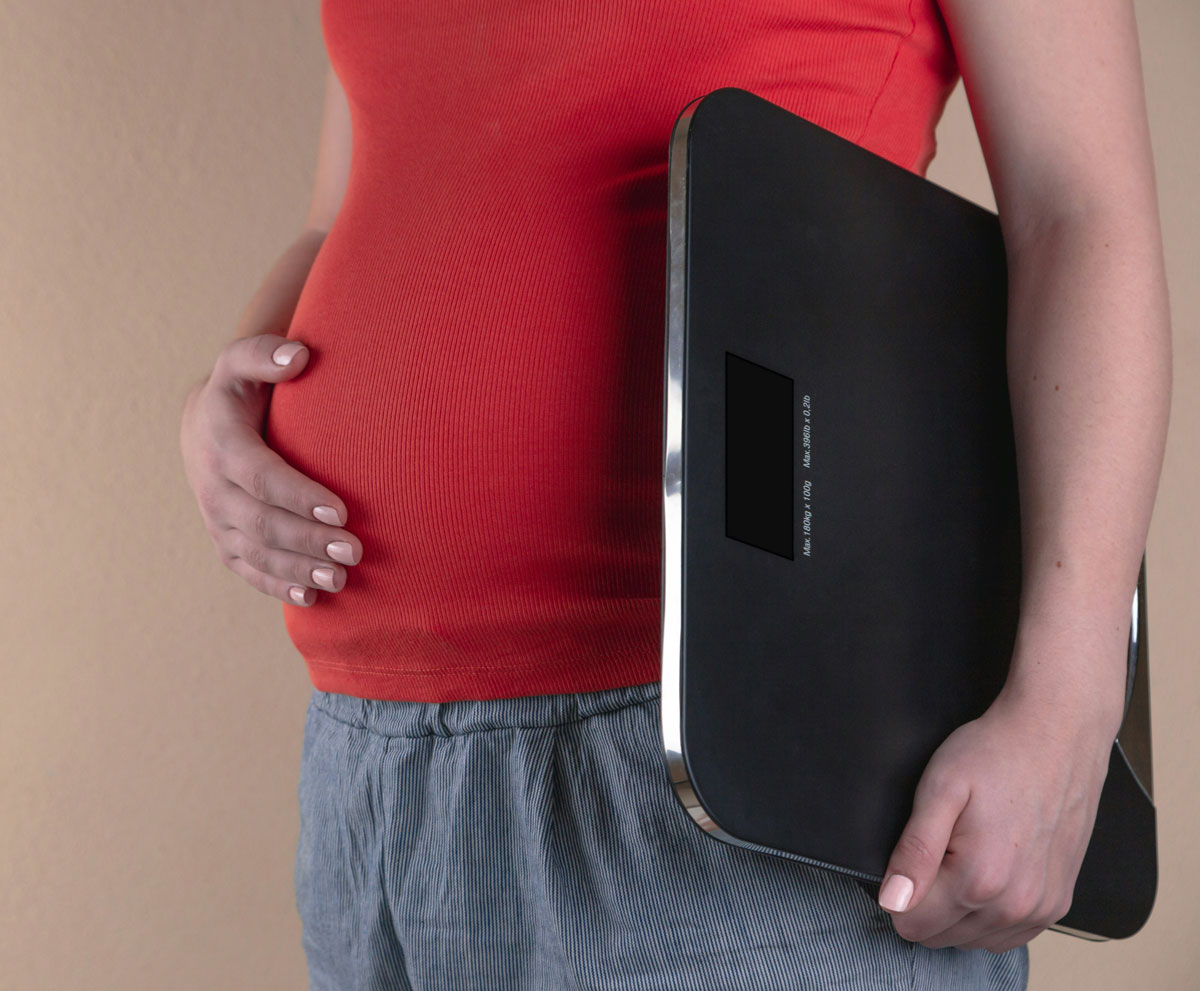
Weight gain during pregnancy is one important measure of how your baby is growing. Eating mostly healthy foods with occasional treats can help keep your weight gain on track.

To get the most accurate reading of your weight, follow these tips:

  • ✓ Weigh yourself at the same time of day. For example, first thing in the morning, after using the restroom, and wearing the same pajamas or light clothing, without shoes.
  • ✓ Weigh yourself once a week, not every day. Your weight can vary a lot from day to day depending on what you eat and drink and your bathroom habits.
  • ✓ Use the same scale each time. Different scales can give different readings so only compare weights from the same scale. Don’t compare your weight at home with your weight at your doctor’s office.

How Much Should You Gain?

The amount of weight you should gain during pregnancy depends on your Body Mass Index (BMI) before becoming pregnant. You can find your BMI here.

Pre-Pregnancy BMI

Recommended Weight Gain in 2nd and 3rd trimester

Total Weight Gain Goal at Delivery

Underweight

BMI <18.5

1 pound

28-40 pounds

Normal Weight

BMI 18.5-24.9

1 pound

25-35 pounds

Overweight

BMI 25-29.9

0.6 pounds

15-25 pounds

Obese

BMI 30 or over

0.5 pounds

11-20 pounds

Why Too Much Weight Gain is a Problem

Gaining too much weight during
pregnancy can:

  • Lead to a larger baby and increase the risk of needing a C-section.
  • Make it harder to lose weight after pregnancy.
  • Increase your baby’s risk of being overweight as they get older.
  • Raise your risk of developing high blood pressure and pre-eclampsia.

Warning signs of preeclampsia:
If you gain more than 3 pounds a week in the 2nd or 3rd trimester and have swollen hands or feet, severe headaches, or trouble seeing, contact your doctor right away! These could be signs of preeclampsia — a serious problem during pregnancy that can harm you and your baby.

Why Not Gaining Enough Weight is a Problem

Not gaining enough weight during pregnancy can:

  • Increase the risk of stillbirth.
  • Increase the risk of your baby being born with a low birthweight or premature.
  • Increase your baby’s risk of having low muscle and fat mass, small length, and smaller head size.
pragnent-women

Common Reasons for Too Much Weight Gain

burger-svg-icon
Eating too much

You don’t need to double your food intake just because you’re “eating for two.”

shoose-svg-icon
Not being active

Moving your body helps burn calories and fat.

weight-scale-svg-icon
Inaccurate weighing

Using different scales or wearing heavy clothes can affect your weight reading.

pragnent-women-svg-icon
Carrying multiples

If your weight gain seems high, talk to your doctor to see if you might be expecting twins or more.

Common Reasons for Not Enough Weight Gain

fit-body-icon
You were underweight before pregnancy

You may have a fast metabolism and may need to work hard to get in the calories you need.

watch-svg-icon
You’re too active or too busy to eat

Try to slow down and set reminders to eat.

heartburn-svg-icon
You can’t eat much due to heartburn, gas, or nausea

Nausea usually goes away in the second trimester. For tips to help heartburn, see Feeling the Burn? Get Heartburn Help Now!

person-svg-icon
Stress, anxiety, depression, and a history of eating disorders

can also affect your appetite and ability to eat. Lack of money to buy food may also be a problem. Talk to your doctor or WIC counselor to discuss eating problems and other food resources.

heart-arrow-svg-icon
Younger women, single women, and those with HIV or gestational diabetes

may also be at risk for not gaining enough weight. Take special care with your diet if these describe you.

Smoking

is also linked with lower weight gain and can also cause many other problems. Try to quit or cut down and reach out to WIC for support.

Is Your Diet Fit for Pregnancy?

Ask yourself these questions:

Do you drink sugary drinks more than twice a week?

Do you eat chips, fries, or processed snacks more than three times a week?

Do you plan your meal portions before eating?

Do you eat the skin on chicken or fat on steak?

Do you eat when you’re bored, sad, or happy instead of when you’re hungry?

Do you eat fast food or fried food more than once a week?

Do you eat while watching TV or using your phone?

Do you watch more than 2 hours of TV or screens daily?

Are you mostly inactive (sitting a lot, not walking much)?

Do you eat fewer than two servings of fruits and vegetables a day?

If you answered yes to four or more questions, you may be at risk of gaining too much weight.

Tips for Healthy Weight Gain

If you’re gaining too much weight…
  • Before you sit down to eat, plan out how much you’ll eat.
  • Avoid or cut down on the amount of fast food and fried food you eat.
  • Choose more whole grains, fruits, and vegetables.
  • Limit sugar-sweetened drinks; choose water instead.
  • Avoid eating while doing something else, like watching TV.
  • Walk or do another doctor-approved exercise for 30 minutes a day, 5 days a week, for a total of 150 minutes each week. Learn more about recommended exercise during pregnancy.
  • Talk with WIC about programs that can help you manage weight gain.
If you’re not gaining enough weight…
  • Don’t skip any food groups. Some women skip dairy or starchy foods. Milk at each meal can help with calories, calcium, and other nutrients.
  • Add cheese to sandwiches, mashed or baked potatoes, pasta, or veggies.
  • Eat often. Getting all the nutrition you need with just 3 meals a day is hard. Snacks can be mini meals like half a sandwich, a bowl of bean soup, or a baked potato with cheese, or smaller snacks like string cheese, yogurt, a fruit smoothie, crackers and peanut butter, or trail mix.
  • Eat more foods with healthy fats like avocado, peanut or sunflower seed butter, bean dip, and hummus. You can also use more oil in cooking and more salad dressing.
  • Try an occasional “healthy splurge” like frozen yogurt, banana or pumpkin bread, egg custard, or pumpkin pie.

If you are underweight before pregnancy,

pay special attention to your weight gain in the second trimester. Research shows that during that time, enough weight gain is important to prevent having a small baby.

Gaining the right amount of weight during pregnancy is important for both you and your baby. Eating healthy, staying active, and tracking your weight can help you stay on track. If you’re unsure about your weight gain, talk to your doctor or WIC for support. Small changes can make a big difference in having a healthy pregnancy!

REFERENCES

León-Muñoz, L. M., García-Esquinas, E., Soler-Vila, H., Guallar-Castillón, P., Banegas, J. R., & Rodríguez-Artalejo, F. (2016). Unhealthy eating behaviors and weight gain: A prospective study in young and middle-age adults. Obesity (Silver Spring), 24(5), 1178–1184.
https://doi.org/10.1002/oby.21477

American College of Obstetricians and Gynecologists. (2021). ACOG Practice Bulletin No. 230: Obesity in pregnancy.
https://www.fasgo.org.ar/images/obesidad-en-el-embarazo.pdf

Teede, H. J., Bailey, C., Moran, L. J., Bahri Khomami, M., Enticott, J., Ranasinha, S., Rogozinska, E., Skouteris, H., Boyle, J. A., Thangaratinam, S., & Harrison, C. L. (2022). Association of antenatal diet and physical activity-based interventions with gestational weight gain and pregnancy outcomes: A systematic review and meta-analysis. JAMA Internal Medicine, 182(2), 106–114.
https://doi.org/10.1001/jamainternmed.2021.6373

Hirko, K. A., Comstock, S. S., Strakovsky, R. S., & Kerver, J. M. (2020). Diet during pregnancy and gestational weight gain in a Michigan pregnancy cohort. Current Developments in Nutrition, 4(8), nzaa121.
https://doi.org/10.1093/cdn/nzaa121

Herring, S. J., Nelson, D. B., Davey, A., Klotz, A. A., Dibble, L. V., Oken, E., & Foster, G. D. (2012). Determinants of excessive gestational weight gain in urban, low-income women. Women’s Health Issues, 22(5), e439–e446.
https://doi.org/10.1016/j.whi.2012.05.004

Catalano, P. M., Mele, L., Landon, M. B., Ramin, S. M., Reddy, U. M., Casey, B., Wapner, R. J., Varner, M. W., Rouse, D. J., Thorp, J. M., Saade, G., Sorokin, Y., Peaceman, A. M., Tolosa, J. E., & Eunice Kennedy Shriver National Institute of Child Health and Human Development Maternal-Fetal Medicine Units Network. (2014). Inadequate weight gain in overweight and obese pregnant women: What is the effect on fetal growth? American Journal of Obstetrics and Gynecology, 211(2), 137.e1-137.e7.
https://doi.org/10.1016/j.ajog.2014.02.004

Darling, A. M., Wang, D., Perumal, N., Liu, E., Wang, M., Ahmed, T., Christian, P., Dewey, K. G., Kac, G., Kennedy, S. H., Subramoney, V., Briggs, B., & Fawzi, W. W. (2023). Risk factors for inadequate and excessive gestational weight gain in 25 low- and middle-income countries: An individual-level participant meta-analysis. PLOS Medicine, 20(7), e1004236.
https://doi.org/10.1371/journal.pmed.1004236

Wei, X., Shen, S., Huang, P., Xiao, X., Lin, S., Zhang, L., Wang, C., Lu, M. S., Lu, J., Tam, W. H., Wang, C. C., He, J. R., & Qiu, X. (2022). Gestational weight gain rates in the first and second trimesters are associated with small for gestational age among underweight women: A prospective birth cohort study. BMC Pregnancy and Childbirth, 22(1), 106.
https://doi.org/10.1186/s12884-022-04433-4

Author: Bridget Swinney MS, RDN, LD

  • Infant
    • The Basics of Paced Bottle-Feeding
    • How Do I Know If My Baby Could Be Tongue-Tied?
    • Protect Your Baby from Cronobacter
    • Exploring the World with Baby – Sensory Play
    • Get Your Baby “Back” to Sleep in a Safe Environment
  • Children
    • Shopping With Kids: A Simple Way to Help Them Like More Foods
    • Pumpkin Fun: Free and Healthy Activities for Kids Under 5
    • Letting Your Child Play with Food Can Be a Good Thing
    • Is Snack Time Treat Time?
    • Fun Ways to Learn About Healthy Food and Get Moving!
  • General /Family
    • Finding Calm When Life Gets Busy: Stress-Management for Parents
    • February Is National Heart Month: Simple Ways to Show Your Heart Some Love
    • 10 Ways to Enjoy Avocados – And Helpful Tips to Feed with Confidence
    • Food, Feelings, and Finding Balance: Understanding Disordered Eating
    • Liquid Calories – Time to Rethink Your Drink?
  • Women
    • Breastfeeding Through Growth Spurts and Sleep Changes
    • Baby Blues… or Is It Something More?
    • Gut Health and Gestational Diabetes
    • Blood Pressure: Do You Know Your Numbers?
    • Make a Plan to Pump
  • Recipes
    • Heart-Healthy Recipe: Banana Berry Oatmeal Cups
    • Is the Chia Seed Challenge Worth It?
    • Extra Vegetables Quiche
    • Easy Pumpkin Muffins
    • Confetti Bean Salad
Wyoming WIC WDH Public Health

CONTACT US

1-888-996-9378
health.wyo.gov/wic
  • How to apply for WIC

Resources

  • WIC Shopper
  • WIC Smart
  • WIC Breastfeeding Support
  • Wyoming Medicaid
  • Wyoming 211
  • Tell a friend about WIC!
  • Guide to Using Your WIC Benefits
  • Wyoming WIC Facebook
  • Wyoming WIC Instagram
  • Wyoming WIC

USDA is an equal opportunity provider, employer, and lender.

Cookie PolicyPrivacy Policy

© Brush Art Corporation
This website is operated by Brush Art Corporation on behalf of the Wyoming Department of Health.

Install this web app on your iPhone: tap and then Add to Home Screen.

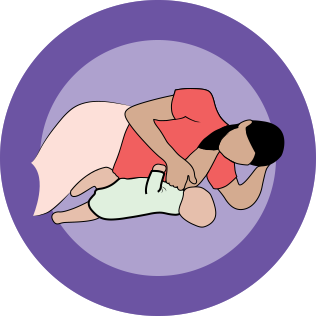
SIDE-LYING HOLD

Side-Lying Hold

  1. For the right breast, lie on your right side with your baby facing you.
  2. Pull your baby close. Your baby’s mouth should be level with your nipple.
  3. In this position, you can cradle your baby’s back with your left arm and support yourself with your right arm and/or pillows.
  4. Keep loose clothing and bedding away from your baby.
  5. Reverse for the left breast.

This hold is useful when:

  • You had a C-section
  • You want to rest while baby feeds
  • You are breastfeeding in the middle of the night
  • You and your baby are comfortable in this position
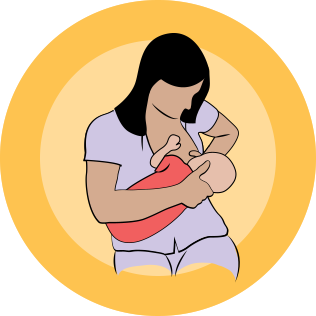
CROSS-CRADLE HOLD

Cross-Cradle Hold

  1. For the right breast, use your left arm to hold your baby’s head at your right breast and baby’s body toward your left side. A pillow across your lap can help support your left arm.
  2. Gently place your left hand behind your baby’s ears and neck, with your thumb and index finger behind each ear and your palm between baby’s shoulder blades. Turn your baby’s body toward yours so your tummies are touching.
  3. Hold your breast as if you are squeezing a sandwich. To protect your back, avoid leaning down to your baby. Instead, bring your baby to you.
  4. As your baby’s mouth opens, push gently with your left palm on baby’s head to help them latch on. Make sure you keep your fingers out of the way.
  5. Reverse for the left breast.

This hold is useful when:

  • Your baby is premature
  • Your baby has a weak suck
  • Your baby needs help to stay latched
  • Your baby needs extra head support
  • You and your baby are comfortable in this position
CLUTCH OR “FOOTBALL” HOLD

Clutch or “Football” Hold

  1. For the right breast, hold your baby level, facing up, at your right side.
  2. Put your baby’s head near your right nipple and support their back and legs under your right arm.
  3. Hold the base of your baby’s head with your right palm. A pillow underneath your right arm can help support your baby’s weight.
  4. To protect your back, avoid leaning down to your baby. Bring baby to you instead.
  5. Reverse for the left breast.

This hold is useful when:

  • You had a C-section
  • You have large breasts
  • You have flat or inverted nipples
  • You have a strong milk let-down
  • You are breastfeeding twins
  • Your baby likes to feed in an upright position
  • Your baby has reflux
  • You and your baby are comfortable in this position
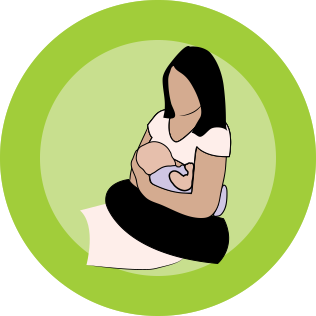
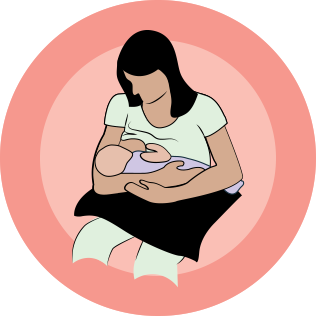
CRADLE HOLD

Cradle Hold

  1. For the right breast, cradle your baby with your right arm. Your baby will be on their left side across your lap, facing you at nipple level.
  2. Your baby’s head will rest on your right forearm with your baby’s back along your inner arm and palm.
  3. Turn your baby’s tummy toward your tummy. Your left hand is free to support your breast, if needed. Pillows can help support your arm and elbow.
  4. To protect your back, avoid leaning down to your baby. Instead, bring your baby to you.
  5. Reverse for the left breast.

This hold is useful when:

  • Your baby needs help latching on
  • You and your baby are comfortable in this position
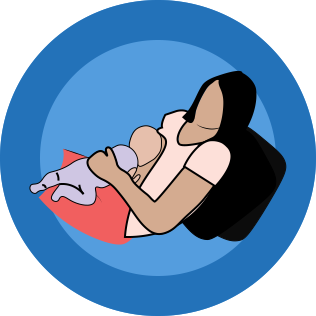
Laid-Back Hold

Laid-Back Hold

  1. Lean back on a pillow with your baby’s tummy touching yours and their head at breast level. Some moms find that sitting up nearly straight works well. Others prefer to lean back and lie almost flat.
  2. You can place your baby’s cheek near your breast, or you may want to use one hand to hold your breast near your baby. It’s up to you and what you think feels best.
  3. Your baby will naturally find your nipple, latch, and begin to suckle.

This hold is useful when:

  • Your baby is placed on your chest right after birth
  • You have a strong milk let-down
  • You have large breasts
  • You and your baby are comfortable in this position