

Skip to Content Skip to Footer
Wyoming WIC
Wyoming WIC
  • Home
  • Women
    • Women
      Breastfeeding
    • Women
      Healthy Tips for Moms
    • Women
      Postpartum
    • Women
      Pregnant
  • Infants
    • Infants
      Feeding & Nutrition
    • Infants
      Growth & Development
  • Children
    • Children
      Toddlers
    • Children
      2-5 Year Olds
  • Families
    • Families
      Activity and Play
    • Families
      Dads
    • Families
      Food & Family Meals
    • Families
      Immunizations
    • Families
      Safety
  • Content Suite
  • Food Shopping Guide
  • Español
A tired mother holding her newborn baby in her arms at home

Postpartum Psychosis: Signs and Where to Get Help

  • Home
  • Content Suite
  • Postpartum Psychosis: Signs and Where to Get Help
wic-postpartum-psychosis-qr
October 21, 2026 Women

store white plus Postpartum Psychosis: Know the Signs and Get Help

Having a baby can bring many changes. It’s common to feel tired, worried, or overwhelmed at times. But sudden changes in a person’s thoughts or behavior may be signs of postpartum psychosis, a rare but serious illness. Postpartum psychosis is different from postpartum depression.

Postpartum psychosis is a medical emergency. Getting help quickly can protect the person who gave birth, the baby, and others. With treatment and support, recovery is possible.

breastmilk Baby What is Postpartum Depression?

Postpartum depression is a mood disorder that begins after a baby is born. It can affect a parent’s mood and ability to manage daily life.

Signs may include:
  • Feeling sad, empty, worried, or hopeless
  • Feeling guilty or like a bad parent
  • Losing interest in things that once brought joy
  • Having little energy
  • Eating or sleeping much more or less than usual
  • Having trouble focusing or making decisions
  • Having trouble feeling close to the baby
  • Thoughts of harming yourself or your baby
Did you know?
A person with postpartum depression typically stays in touch with reality. They know where they are and understand what is happening around them. However, postpartum depression is still a serious condition that needs prompt care. A health care provider can help with counseling, medicine, or both.

blue alert What is Postpartum Psychosis?

Postpartum psychosis affects the way a person thinks and understands what is real. Symptoms often begin suddenly, usually during the first two weeks after birth, but they can also begin later.

Signs may include:

  • Hearing or seeing things that others do not
  • Strongly believing things that are not true
  • Feeling very confused or unable to communicate clearly
  • Feeling watched, followed, or unsafe for no clear reason
  • Having very fast thoughts or speech
  • Feeling unusually excited, powerful, restless, or full of energy
  • Having quick and extreme mood changes
  • Sleeping very little or feeling no need to sleep
postpartum-psychosis-affects-the-way-person
  • A person with postpartum psychosis may not realize that something is wrong. Their words or actions may not make sense to others. Postpartum psychosis requires emergency care and generally requires treatment in a hospital. Treatment may include medicine and other therapies recommended by a medical team.
  • Most people with postpartum psychosis do not harm themselves or anyone else. Still, psychosis can affect judgment and make it difficult to recognize danger. If postpartum psychosis may be happening, call 911 or go to the nearest emergency room – even if the person does not think they need help.
Why Immediate Help Matters

Thoughts of suicide or harming oneself or the baby need immediate help.
Call or text 988 for crisis support. If there is immediate danger, call 911.

twohand Safely How are Postpartum Depression and Postpartum Psychosis Different?

mother-crying-newborn
Postpartum Depression
  • ✓ Mainly affects mood, energy, and daily life
  • ✓ May cause sadness, worry, guilt, or loss of interest
  • ✓ A person typically remains in touch with reality
  • ✓ Needs prompt care from a health care provider
father-comforting-mother
Postpartum Psychosis
  • ✓ Affects the ability to understand what is real
  • ✓ May cause false beliefs, hallucinations, paranoia, or severe confusion
  • ✓ A person may lose touch with reality
  • ✓ Needs emergency medical care right away

Both are real health conditions.
Neither condition is the parent’s fault, and neither means someone is a bad parent.

Remember!

question develop Who Can Develop Postpartum Psychosis?

Postpartum psychosis affects 1 to 2 out of every 1,000 people who haven recently given birth. The risk may be higher for someone who has bipolar disorder, has experienced psychosis before, or has a family history of these conditions. However, postpartum psychosis can happen even when there is no known mental health history. Families should never blame themselves or the person experiencing the illness.
Red triangular warning sign with exclamation mark

If you notice signs of postpartum psychosis call 911 or go to the nearest emergency room right away. Do not leave the person alone. Ask another trusted adult to care for the baby while help is being arranged.
Do not wait to see whether the symptoms go away on their own.

build healthy How Loved Ones Can Help

Family members and friends may notice the warning signs before the parent does. If something does not seem right, trust your concern and act quickly.

  • ✓ Stay calm and use short, simple sentences.
  • ✓ Do not argue about what the person believes, sees, or hears.
  • ✓ Stay with the parent until help arrives.
  • ✓ Ask another trusted adult to care for the baby.
  • ✓ Call 911 or go to an emergency room.
  • ✓ Tell the medical team that the person recently gave birth and may have postpartum psychosis.
couple-with-doctor-clinic

breastmilk white plus Free Support is Available

988_Suicide

988 Suicide & Crisis Lifeline

Call or text 988, or use the online chat at 988lifeline.org. Support is free, confidential, and available 24 hours a day. Click here to learn more:

988lifeline.org
PSI-Round-words

National Maternal Mental Health Hotline

Call or text 1-833-TLC-MAMA (1-833-852-6262). This free, confidential hotline is available 24 hours a day in English and Spanish. Interpreters are available in many other languages. Partners and family members may call, too. Trained counselors can listen and connect families with local care. Click here to learn more:

mchb.hrsa.gov
Thumbnails

Postpartum Support International HelpLine

Call 1-800-944-4773 or text HELP to 800-944-4773 for support in English. For Spanish, text 971-203-7773. This HelpLine offers information and connections to local resources, but it is not an emergency line. Click here to learn more:

postpartum.net

PSI also offers a free online support group for people recovering from postpartum psychosis. This group is for people who are no longer experiencing active psychosis.
Click here to learn more:

Pregnancy and Postpartum Psychosis Support for Survivors

women wic A Final Note

You can also talk with your WIC staff, doctor, midwife, or another trusted health care provider.
WIC staff can listen without judgment and help connect your family with support. If postpartum psychosis may be happening, get emergency care first.

Postpartum psychosis is serious, but it’s also treatable. Getting help quickly is an act of care for the parent, the baby, and the whole family.

REFERENCES:

Friedman, S. H., Reed, E., & Ross, N. E. (2023). Postpartum psychosis. Current Psychiatry Reports, 25(2), 65–72.
https://doi.org/10.1007/s11920-022-01406-4

National Institute of Mental Health. (2023). Perinatal Depression.
https://www.nimh.nih.gov/health/publications/perinatal-depression

Postpartum Support International. (n.d.). Perinatal/Postpartum Psychosis Help.
https://postpartum.net/get-help/postpartum-psychosis-help/

United States Department of Health & Human Services. Office on Women’s Health. (2023, October 17). Postpartum depression.
https://womenshealth.gov/mental-health/mental-health-conditions/postpartum-depression

Author: Amanda Hojnacki

Do you find this Blog helpful?

Show some love here!

SMS Communication Consent

No comments yet. Be the first to share your thoughts!

Scroll To Top

You May Also Like...

September 30, 2026

Breastfeeding After a C-Section: Tips for WIC Moms

If you just had a C-section, or are planning to have one, you might be wondering: Can I still breastfeed my baby? The answer is a big YES! While recovering…

Read More
0
0
August 26, 2026

Breastfeeding Nipple Pain: What’s Normal and When to Get Help

Many new parents are told that breastfeeding is supposed to hurt at first. You may even hear that you just have to “push through the pain.” The truth is, breastfeeding…

Read More
0
0
August 12, 2026

Cluster Feeding Explained | WIC Breastfeeding Support

If it feels like your baby wants to breastfeed all the time, you’re not alone. Many new parents worry that frequent feeding means something is wrong or that their baby…

Read More
0
0
WATCH VIDEOS
  • Infant
    • Infant Pacifiers: Benefits, Safety Tips, and When to Wean
    • When to Start Peanut and Egg to Help Prevent Allergies
    • The Basics of Paced Bottle-Feeding
    • How Do I Know If My Baby Could Be Tongue-Tied?
    • Protect Your Baby from Cronobacter
  • Children
    • Food, Feelings, and Your Child’s Health | How Nutrition Affects Mood
    • Simple Child Safety Tips Every Parent Should Know
    • Shopping With Kids: A Simple Way to Help Them Like More Foods
    • Pumpkin Fun: Free and Healthy Activities for Kids Under 5
    • Letting Your Child Play with Food Can Be a Good Thing
  • General /Family
    • Kid-Friendly Apple Cinnamon Oat Cups | WIC Recipe
    • Protecting Your Family from Cyclospora: Summer Food & Water Safety
    • The Benefits of Family Meals for Kids and Parents
    • Meet the Milks: Dairy and Plant-Based Choices
    • Avoiding Food Waste
  • Women
    • Breastfeeding After a C-Section: Tips for WIC Moms
    • Breastfeeding Nipple Pain: What’s Normal and When to Get Help
    • Cluster Feeding Explained | WIC Breastfeeding Support
    • Breastfeeding Support Available Through WIC | Pumps, Peer Counselors & More
    • How Partners Can Support Breastfeeding
  • Recipes
    • Boo-Berry Yogurt Cups: Easy Halloween Snack for Kids
    • Rainbow Fruit Salsa with Cinnamon Chips | Healthy Family Snack Recipe
    • Healthy Red, White, and Blue Snacks for Kids
    • Simple Meals with Canned Fish: Easy, Healthy & Budget-Friendly Ideas
    • Fresh & Easy Spring Snacks for Toddlers
Wyoming WIC WDH Public Health

CONTACT US

1-888-996-9378
health.wyo.gov/wic
  • How to apply for WIC

Resources

  • WIC Shopper
  • WIC Smart
  • WIC Breastfeeding Support
  • Wyoming Medicaid
  • Wyoming 211
  • Tell a friend about WIC!
  • Guide to Using Your WIC Benefits
  • Wyoming WIC Facebook
  • Wyoming WIC Instagram
  • Wyoming WIC

USDA is an equal opportunity provider, employer, and lender.

Cookie PolicyPrivacy Policy

© Brush Art Corporation
This website is operated by Brush Art Corporation on behalf of the Wyoming Department of Health.

Install this web app on your iPhone: tap and then Add to Home Screen.
Share to Social

Share this link via

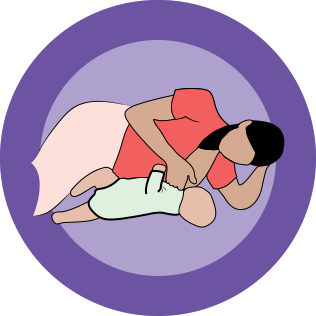
SIDE-LYING HOLD

Side-Lying Hold

  1. For the right breast, lie on your right side with your baby facing you.
  2. Pull your baby close. Your baby’s mouth should be level with your nipple.
  3. In this position, you can cradle your baby’s back with your left arm and support yourself with your right arm and/or pillows.
  4. Keep loose clothing and bedding away from your baby.
  5. Reverse for the left breast.

This hold is useful when:

  • You had a C-section
  • You want to rest while baby feeds
  • You are breastfeeding in the middle of the night
  • You and your baby are comfortable in this position
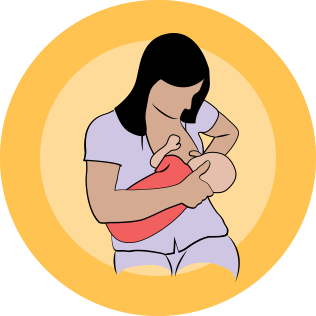
CROSS-CRADLE HOLD

Cross-Cradle Hold

  1. For the right breast, use your left arm to hold your baby’s head at your right breast and baby’s body toward your left side. A pillow across your lap can help support your left arm.
  2. Gently place your left hand behind your baby’s ears and neck, with your thumb and index finger behind each ear and your palm between baby’s shoulder blades. Turn your baby’s body toward yours so your tummies are touching.
  3. Hold your breast as if you are squeezing a sandwich. To protect your back, avoid leaning down to your baby. Instead, bring your baby to you.
  4. As your baby’s mouth opens, push gently with your left palm on baby’s head to help them latch on. Make sure you keep your fingers out of the way.
  5. Reverse for the left breast.

This hold is useful when:

  • Your baby is premature
  • Your baby has a weak suck
  • Your baby needs help to stay latched
  • Your baby needs extra head support
  • You and your baby are comfortable in this position
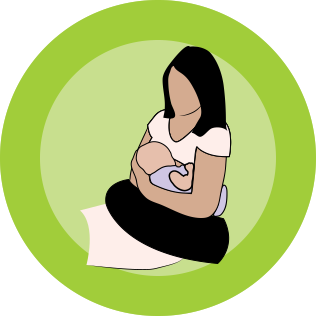
CLUTCH OR “FOOTBALL” HOLD

Clutch or “Football” Hold

  1. For the right breast, hold your baby level, facing up, at your right side.
  2. Put your baby’s head near your right nipple and support their back and legs under your right arm.
  3. Hold the base of your baby’s head with your right palm. A pillow underneath your right arm can help support your baby’s weight.
  4. To protect your back, avoid leaning down to your baby. Bring baby to you instead.
  5. Reverse for the left breast.

This hold is useful when:

  • You had a C-section
  • You have large breasts
  • You have flat or inverted nipples
  • You have a strong milk let-down
  • You are breastfeeding twins
  • Your baby likes to feed in an upright position
  • Your baby has reflux
  • You and your baby are comfortable in this position
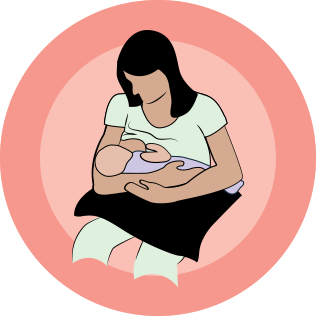
CRADLE HOLD

Cradle Hold

  1. For the right breast, cradle your baby with your right arm. Your baby will be on their left side across your lap, facing you at nipple level.
  2. Your baby’s head will rest on your right forearm with your baby’s back along your inner arm and palm.
  3. Turn your baby’s tummy toward your tummy. Your left hand is free to support your breast, if needed. Pillows can help support your arm and elbow.
  4. To protect your back, avoid leaning down to your baby. Instead, bring your baby to you.
  5. Reverse for the left breast.

This hold is useful when:

  • Your baby needs help latching on
  • You and your baby are comfortable in this position
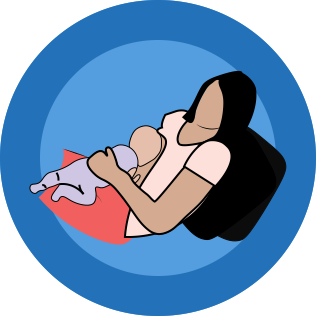
Laid-Back Hold

Laid-Back Hold

  1. Lean back on a pillow with your baby’s tummy touching yours and their head at breast level. Some moms find that sitting up nearly straight works well. Others prefer to lean back and lie almost flat.
  2. You can place your baby’s cheek near your breast, or you may want to use one hand to hold your breast near your baby. It’s up to you and what you think feels best.
  3. Your baby will naturally find your nipple, latch, and begin to suckle.

This hold is useful when:

  • Your baby is placed on your chest right after birth
  • You have a strong milk let-down
  • You have large breasts
  • You and your baby are comfortable in this position