Skip to Content Skip to Footer
Wyoming WIC
Wyoming WIC
  • Home
  • Women
    • Women
      Breastfeeding
    • Women
      Healthy Tips for Moms
    • Women
      Postpartum
    • Women
      Pregnant
  • Infants
    • Infants
      Feeding & Nutrition
    • Infants
      Growth & Development
  • Children
    • Children
      Toddlers
    • Children
      2-5 Year Olds
  • Families
    • Families
      Activity and Play
    • Families
      Dads
    • Families
      Food & Family Meals
    • Families
      Immunizations
    • Families
      Safety
  • Live Well Blog
  • Food Shopping Guide
  • Español

Getting to know your toddler:

6 Months to 2 Years

  • Home
  • Children
  • Toddlers
  • Getting To Know Your Toddler
The 6 Big Changes for Older Babies and Toddlers
Grow More Slowly
Must Practice Their New Motor Skills
Need to Practice Using Their Fingers
Need Family and Friends to Help Them Learn
Get Better at Remembering Things
Use Scripts to Predict What is Going to Happen

Between 6 months and 2 years of age, babies become toddlers. Your child will start walking, talking, and interacting more with the world around him.

It can be hard to figure out what your child needs or why he behaves the way he does. You may wonder why he doesn’t eat as much as you expect. Some days he will eat at every meal and some days he will push food away. You may feel confused or frustrated when he gets upset. You may wonder why he can’t control his emotions. These behaviors are normal. They happen because of 6 developmental changes that all older babies and toddlers go through. These 6 Big Changes impact how your child eats, plays, learns, sleeps, and communicates.

The 6 Big Changes For Older Babies and Toddlers

Between 6 months and 2 years of age, children:

Grow More
Slowly

They get bigger and stronger but their growth slows down.

Section Redirect Button

Must Practice Their
New Motor Skills

They must practice new skills like crawling, standing, and walking.
Section Redirect Button

Need to Practice
Using Their Fingers

They have a strong need to practice exploring with their fingers. They love learning to feed themselves.

Section Redirect Button

Need Family and Friends
to Help Them Learn

They like to point at things to ask their caregivers to tell them what they see.

Section Redirect Button

Get Better at
Remembering Things

Their memories get better as they get older. They can remember what they like and don’t like.
Section Redirect Button

Use Scripts to Predict
What is Going to Happen

They remember patterns in their lives to learn about the world around them.

Section Redirect Button

Grow More Slowly

Your child needs healthy food to help her grow bigger and stronger each day.
During her first few months, she needed to eat more and more because she was growing very fast. Now that she is older, you will notice that she is not growing as fast. Her appetite is not growing as fast either. She will still eat more as she grows, but it will take time before she is eating a lot more than she is eating now. It is common for children to eat a lot one day and less the next day.

Around 9 or 10 months old, it is natural for children to start growing more slowly.

What You See:

  • He will not grow out of his clothes as quickly as he did when he was younger.
  • He will be better at showing you when he is still hungry or has had enough.
  • The amount of food he eats will not increase as fast as it did when he was younger. He may not always eat as much as you expect.
  • His appetite may change from meal to meal or day to day.
Tips to Try:
  • Watch for your child’s cues to know when he is hungry and full.
  • Start by offering one small portion. Offer more if he finishes and shows you he is still hungry.
  • Provide healthy meals and snacks. Let him decide when he is done eating. Try not to worry about how much he eats at each meal.
  • Offer him a variety of healthy foods each day and throughout the week.
  • If you are concerned about his growth, talk to WIC or a health care professional.

MUST PRACTICE THEIR NEW MOTOR SKILLS

Between 6 months and 2 years of age, children learn to move in new and exciting ways!
Your child works hard to sit up, crawl, stand, and walk. It takes a lot of practice to learn these new skills. Your child’s body is telling him to keep practicing until he gets it right. Sometimes, the need to move his body is so strong, he may want to practice even more than he wants to eat or sleep. Once he learns a new skill, he will not be so focused on practicing.

What You See:

When your child is learning a new skill, she may:

  • Wake up during the night to practice.
  • Have trouble sitting still.
  • Cry or get frustrated when she cannot practice.
  • Be less focused on eating.

Tips to Try:

  • Make sure she has safe spaces to practice her new skills.
  • Give her time to move and practice throughout the day. More practice during the day can help her sleep better at night.
  • Use the car seat and stroller only when needed for safe transportation.
  • Make learning a fun activity. She needs friends and family to help her learn to crawl and walk.

NEED TO PRACTICE USING THEIR FINGERS

Your child is learning to use his fingers.
He wants to hold things, explore the world, and feed himself. Using his hands in new ways takes a lot of time and practice. Sometimes, practicing can be more important to him than eating or sleeping. It is easy to think that babies and toddlers reach for or put things in their mouths only when they are hungry. This is also how they explore and learn. Your child needs your help to know what is safe to touch and what is good to eat.

What You See:

Your child may get upset when he cannot use his fingers the way he wants. He may:

  • Refuse to eat foods that he cannot pick up himself.
  • Want to play with his food.
  • Get messy at mealtime.
  • Cry or get mad when he cannot feed himself or hold something he wants.
  • Reach for items that he cannot have.
Tips to Try:
  • Give her foods that she can safely pick up and eat with her hands. You can feed her with a spoon and give her finger foods during the same meal.
  • Be patient! Let your child have time to explore new foods and get ready for a playful mess.
  • Keep a damp cloth nearby during meals and snacks for quick clean up.
  • Let her practice using her fingers to pick up and hold toys or other safe objects.
  • Make sure that only safe things are in your child’s reach.

NEED FAMILY AND FRIENDS TO HELP THEM LEARN

The world is a big confusing place.
Your child will be very curious about the things she sees and hears. She learns a lot by playing and interacting with the people around her. She may point at things because she wants you to tell her about what she sees. Sometimes she may be asking for what she points to. Other times, she will be happy just hearing you talk about it.

Your child can learn healthy habits by watching you. She wants to do the same things you do and eat the same foods you eat. With your help, she will learn what she can have, where she can go, what she can do, and what she can touch.

What You See:
Your older baby or toddler may:
  • Look at, point to, or try to touch things that interest her. She sometimes points at food even when she is not hungry.
  • Make noises, wiggle or even cry to get your attention so that you will help her learn. She will want you to talk to her and let her explore safe things.
  • Watch your reactions to foods, objects, and even people to learn how she should react.
  • Pay attention to people nearby instead of eating.

Tips to Try:

  • Talk to your child about things he sees to help him learn about his world. Name what he is pointing at.
  • Take a moment right away to respond to him, even when you are busy. He will stay happy and you can get back to what you are doing faster.
  • Make sure you smile and speak gently when you want him to try something new. If you look upset, he will be cautious or turn away.
  • Eat together. Make meal and snack times social and fun.
  • Keep him away from dangerous things. He cannot control his hands or body.

GET BETTER AT REMEMBERING THINGS

As your child gets older, he remembers more and more.
He remembers the things he sees, hears, smells, and tastes. He remembers what he likes and does not like. He also remembers the jobs or roles people have in his life. For example, he remembers that you feed him and grandma takes him to the park. Having a better memory helps him learn. It is also fun. He enjoys predicting things, so games like peek-aboo make him laugh!

What You See:

Your older baby or toddler may:
  • Notice things that are new to him, like new foods, people, or toys.
  • Know how, when, and where things happen. For example, he might remember details about mealtime.
  • Start to refuse foods that he does not like. Sometimes he will not eat foods that look like foods he does not like.
  • Get upset when someone does not do their job or tries to do someone else’s job. For example, when someone else feeds him or gives him a bath.
  • Be shy around people he does not know well.

Tips to Try:

  • Let your child see, touch, and smell small amounts of new foods many times. She is more likely to try familiar foods.
  • Be patient! It may take time for your child to get used to new people.
  • Offer her a variety of foods and eat with her so she can see what you like.
  • Keep favorite foods that are not part of the meal or snack out of sight when offering new foods.

USE SCRIPTS TO PREDICT WHAT IS GOING TO HAPPEN

Your child is better at remembering patterns in his life.
When he notices the same things happening in the same order, like during diaper changes and mealtime, he remembers all the steps.

He makes a script of the steps in his mind so he will know what will happen next time. These scripts are much like a movie script with one scene following the next. He may get upset when things don’t happen the way he expects. You can create routines for activities that you want to go smoothly. Your child will remember the steps in the routine and make scripts about those activities. To make a routine, use the same steps in the same order each time. A routine is different than a schedule. It’s the order of the steps, not the time on the clock that matters. If you repeat the routine over and over, your child will soon make a new script in his mind. Knowing what will happen next helps him feel relaxed and safe.

What You See:
Your older baby or toddler may:
  • Start to predict what comes next during activities she does every day.
  • Get upset when there are changes to daily activities.
  • Want the same people to do certain things for her.
  • Get frustrated if you change the things you do before, during, or after she eats.
  • Be confused when a new person tries to feed her.

Tips to Try:

  • Create a routine when you want your child to be calm and cooperative.
  • Use routines that work for you and your family. Routines do not need to be complicated.
  • Be consistent when creating a new routine. It will take time for your child to learn the new steps.
  • Keep mealtime routines the same when possible.
  • Keep a consistent bedtime routine to help your child fall asleep sooner and stay asleep longer.

Families grow healthy with WIC.

Adapted with permission from California WIC and UC Davis Human Lactation Center:

Getting to Know Your Toddler: 6 Months to 2 Years. Accessed February 20, 2025. https://docs.wic.ca.gov/Content/Documents/NutritionHealth/Toddler/WIC-TOTTS-Booklet.pdf
Wyoming WIC WDH Public Health

CONTACT US

1-888-996-9378
health.wyo.gov/wic
  • How to apply for WIC

Resources

  • WIC Shopper
  • WIC Smart
  • WIC Breastfeeding Support
  • Wyoming Medicaid
  • Wyoming 211
  • Tell a friend about WIC!
  • Guide to Using Your WIC Benefits
  • Wyoming WIC Facebook
  • Wyoming WIC Instagram
  • Wyoming WIC

USDA is an equal opportunity provider, employer, and lender.

Cookie PolicyPrivacy Policy

© Brush Art Corporation
This website is operated by Brush Art Corporation on behalf of the Wyoming Department of Health.

Install this web app on your iPhone: tap and then Add to Home Screen.
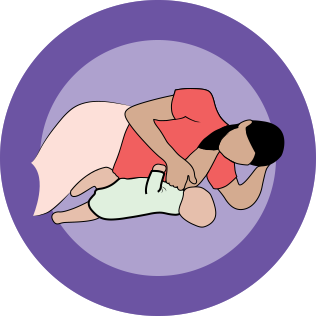
SIDE-LYING HOLD

Side-Lying Hold

  1. For the right breast, lie on your right side with your baby facing you.
  2. Pull your baby close. Your baby’s mouth should be level with your nipple.
  3. In this position, you can cradle your baby’s back with your left arm and support yourself with your right arm and/or pillows.
  4. Keep loose clothing and bedding away from your baby.
  5. Reverse for the left breast.

This hold is useful when:

  • You had a C-section
  • You want to rest while baby feeds
  • You are breastfeeding in the middle of the night
  • You and your baby are comfortable in this position
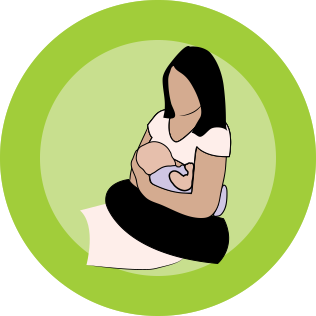
CROSS-CRADLE HOLD

Cross-Cradle Hold

  1. For the right breast, use your left arm to hold your baby’s head at your right breast and baby’s body toward your left side. A pillow across your lap can help support your left arm.
  2. Gently place your left hand behind your baby’s ears and neck, with your thumb and index finger behind each ear and your palm between baby’s shoulder blades. Turn your baby’s body toward yours so your tummies are touching.
  3. Hold your breast as if you are squeezing a sandwich. To protect your back, avoid leaning down to your baby. Instead, bring your baby to you.
  4. As your baby’s mouth opens, push gently with your left palm on baby’s head to help them latch on. Make sure you keep your fingers out of the way.
  5. Reverse for the left breast.

This hold is useful when:

  • Your baby is premature
  • Your baby has a weak suck
  • Your baby needs help to stay latched
  • Your baby needs extra head support
  • You and your baby are comfortable in this position
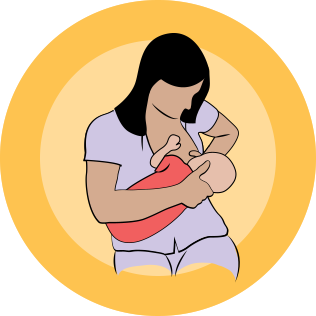
CLUTCH OR “FOOTBALL” HOLD

Clutch or “Football” Hold

  1. For the right breast, hold your baby level, facing up, at your right side.
  2. Put your baby’s head near your right nipple and support their back and legs under your right arm.
  3. Hold the base of your baby’s head with your right palm. A pillow underneath your right arm can help support your baby’s weight.
  4. To protect your back, avoid leaning down to your baby. Bring baby to you instead.
  5. Reverse for the left breast.

This hold is useful when:

  • You had a C-section
  • You have large breasts
  • You have flat or inverted nipples
  • You have a strong milk let-down
  • You are breastfeeding twins
  • Your baby likes to feed in an upright position
  • Your baby has reflux
  • You and your baby are comfortable in this position
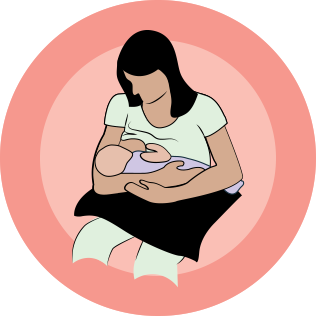
CRADLE HOLD

Cradle Hold

  1. For the right breast, cradle your baby with your right arm. Your baby will be on their left side across your lap, facing you at nipple level.
  2. Your baby’s head will rest on your right forearm with your baby’s back along your inner arm and palm.
  3. Turn your baby’s tummy toward your tummy. Your left hand is free to support your breast, if needed. Pillows can help support your arm and elbow.
  4. To protect your back, avoid leaning down to your baby. Instead, bring your baby to you.
  5. Reverse for the left breast.

This hold is useful when:

  • Your baby needs help latching on
  • You and your baby are comfortable in this position
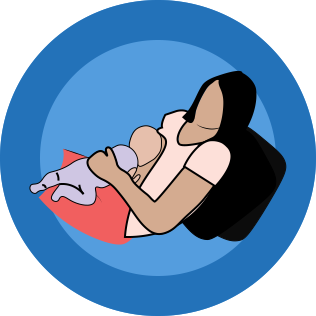
Laid-Back Hold

Laid-Back Hold

  1. Lean back on a pillow with your baby’s tummy touching yours and their head at breast level. Some moms find that sitting up nearly straight works well. Others prefer to lean back and lie almost flat.
  2. You can place your baby’s cheek near your breast, or you may want to use one hand to hold your breast near your baby. It’s up to you and what you think feels best.
  3. Your baby will naturally find your nipple, latch, and begin to suckle.

This hold is useful when:

  • Your baby is placed on your chest right after birth
  • You have a strong milk let-down
  • You have large breasts
  • You and your baby are comfortable in this position